
Anthony Hopkins – Van Helsing writes to Van Helsing [Dracula Interest]
£2,750.00
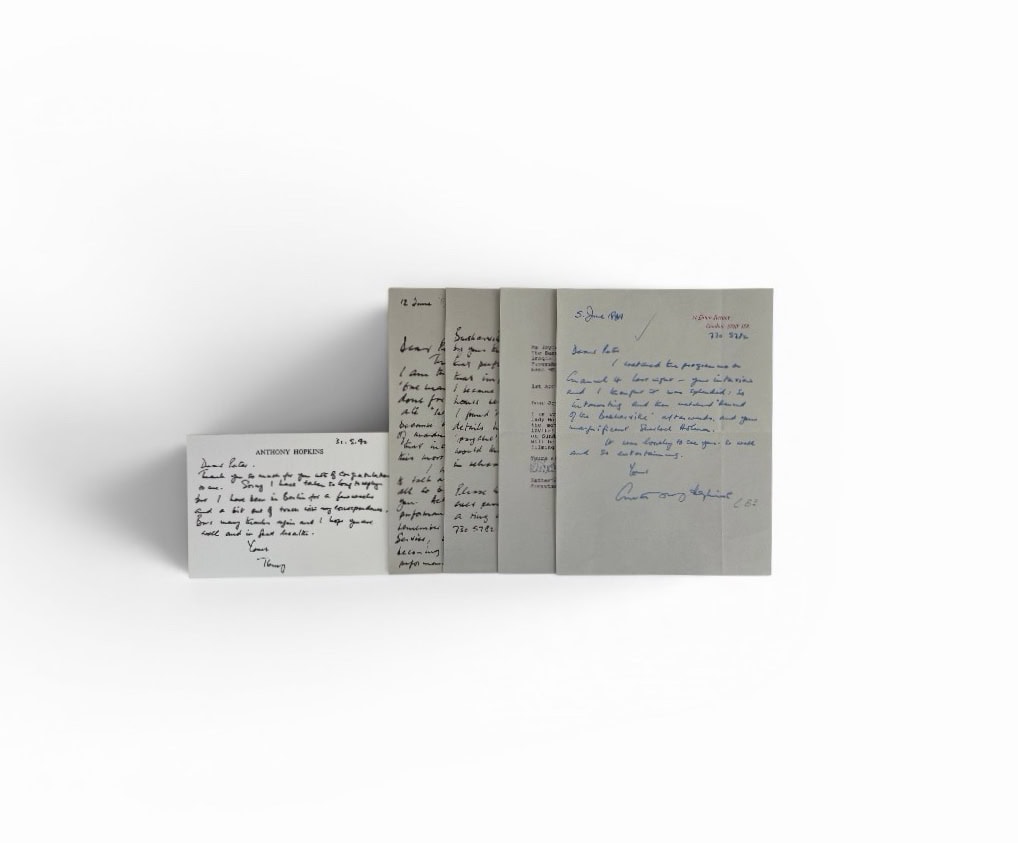
Two autograph letters signed, to Peter Cushing, together with an autograph postcard signed and a typed note from Hopkins’ secretary, all reflecting the warm correspondence between the two actors, and containing Hopkins’ striking tribute to Cushing’s performance in Hammer’s The Hound of the Baskervilles (1959), which he credits as an early and lasting influence on his own approach to acting. London, [1987–93].
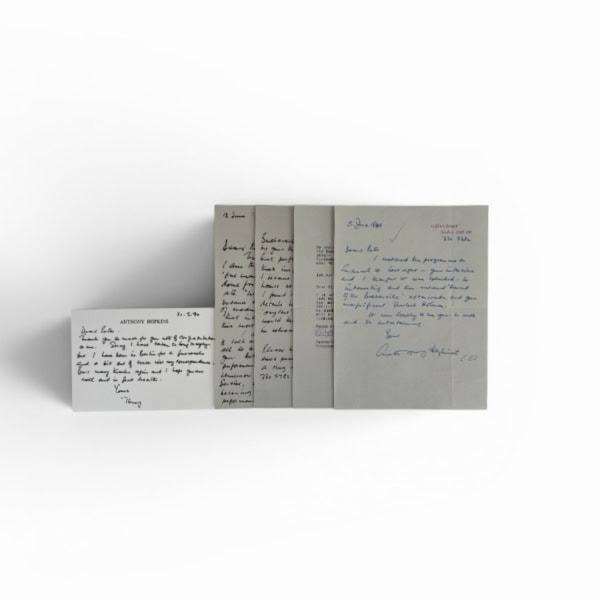
Two autograph letters signed, both on personal stationery, with a signed autograph postcard and a typed note from Hopkins’ secretary to Cushing’s. Without envelopes. A few light folds and occasional trivial smudging, but in all a notably well-preserved group.
A revealing and affectionate series of communications between Anthony Hopkins and Peter Cushing, prompted by a letter Cushing wrote to Hopkins in the summer of 1987. In his reply, Hopkins thanks Cushing for his “lovely letter” and, in a passage of unusual biographical interest, recalls the profound impression made on him by Cushing’s performance as Sherlock Holmes in Hammer’s The Hound of the Baskervilles. Writing of a time before he had even conceived of becoming an actor, Hopkins remembers being so struck by the “precision and perfectionism” of Cushing’s performance that, when he himself later entered the profession, he consciously held it in mind, spending “hours rehearsing details” alone until they had been absorbed into the “psyche”.
The second letter, written two years later, congratulates Cushing on a Channel 4 interview, after which Hopkins watched The Hound of the Baskervilles again, praising Cushing’s “magnificent Sherlock Holmes” and remarking how lovely it was to see him “so well and so entertaining”.
The accompanying postcard, written in May 1992, thanks Cushing for his congratulations, almost certainly on Hopkins’ Academy Award for The Silence of the Lambs; the typed note of 1993 expresses Hopkins’ regret that prior commitments prevented him from attending Cushing’s surprise eightieth birthday celebration. Taken together, the group offers an intimate glimpse of the mutual admiration and enduring regard between two distinguished actors, each associated, in different generations, with the great Gothic tradition: Cushing as Van Helsing in Hammer’s Dracula films, Hopkins in Coppola’s 1992 Dracula.
A warm, uncommon, and revealing collection from one Van Helsing to another and a superb insight into Hopkins’ acting inspirations.
(We don't keep all of our stock in the shop, so send us an email if you're planning a trip to see a particular author or book.)
- Description
Description
Two autograph letters signed, to Peter Cushing, together with an autograph postcard signed and a typed note from Hopkins’ secretary, all reflecting the warm correspondence between the two actors, and containing Hopkins’ striking tribute to Cushing’s performance in Hammer’s The Hound of the Baskervilles (1959), which he credits as an early and lasting influence on his own approach to acting. London, [1987–93].
Two autograph letters signed, both on personal stationery, with a signed autograph postcard and a typed note from Hopkins’ secretary to Cushing’s. Without envelopes. A few light folds and occasional trivial smudging, but in all a notably well-preserved group.
A revealing and affectionate series of communications between Anthony Hopkins and Peter Cushing, prompted by a letter Cushing wrote to Hopkins in the summer of 1987. In his reply, Hopkins thanks Cushing for his “lovely letter” and, in a passage of unusual biographical interest, recalls the profound impression made on him by Cushing’s performance as Sherlock Holmes in Hammer’s The Hound of the Baskervilles. Writing of a time before he had even conceived of becoming an actor, Hopkins remembers being so struck by the “precision and perfectionism” of Cushing’s performance that, when he himself later entered the profession, he consciously held it in mind, spending “hours rehearsing details” alone until they had been absorbed into the “psyche”.
The second letter, written two years later, congratulates Cushing on a Channel 4 interview, after which Hopkins watched The Hound of the Baskervilles again, praising Cushing’s “magnificent Sherlock Holmes” and remarking how lovely it was to see him “so well and so entertaining”.
The accompanying postcard, written in May 1992, thanks Cushing for his congratulations, almost certainly on Hopkins’ Academy Award for The Silence of the Lambs; the typed note of 1993 expresses Hopkins’ regret that prior commitments prevented him from attending Cushing’s surprise eightieth birthday celebration. Taken together, the group offers an intimate glimpse of the mutual admiration and enduring regard between two distinguished actors, each associated, in different generations, with the great Gothic tradition: Cushing as Van Helsing in Hammer’s Dracula films, Hopkins in Coppola’s 1992 Dracula.
A warm, uncommon, and revealing collection from one Van Helsing to another and a superb insight into Hopkins’ acting inspirations.
