


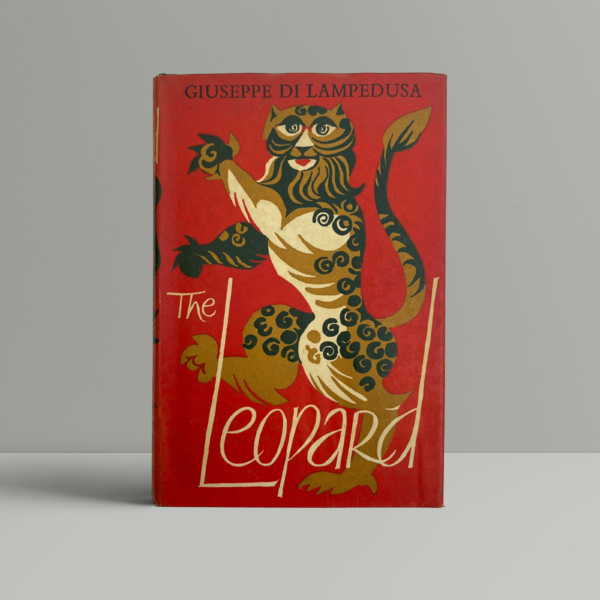


Giuseppe Di Lampedusa – The Leopard – First UK Edition 1960

£175.00
A first edition, first printing of The Leopard by Giuseppe Di Lampedusa, published by Collins Harvill, London in 1960. A very good copy free from intenal inscriptions, toning to the text block. In a near fine unclipped wrapper, fading to the spine chipping to the spine tips and knuckles of front and rear flap folds, a closed tear to bottom edge or rear panel.
The Leopard by Giuseppe Tomasi di Lampedusa is an historical novel set in Sicily during Italy’s Risorgimento. It portrays Prince Fabrizio of Salina, an aristocrat witnessing the decline of his class as political and social change sweeps the island. Through his reflections, Lampedusa explores mortality, tradition and the futility of resisting history. The prince’s nephew Tancredi embraces the new order, embodying survival through adaptation. Richly elegiac, the novel examines decay, transformation and the tension between permanence and change.
(We don't keep all of our stock in the shop, so send us an email if you're planning a trip to see a particular author or book.)
- Description
Description
A first edition, first printing of The Leopard by Giuseppe Di Lampedusa, published by Collins Harvill, London in 1960. A very good copy free from intenal inscriptions, toning to the text block. In a near fine unclipped wrapper, fading to the spine chipping to the spine tips and knuckles of front and rear flap folds, a closed tear to bottom edge or rear panel.
The Leopard by Giuseppe Tomasi di Lampedusa is an historical novel set in Sicily during Italy’s Risorgimento. It portrays Prince Fabrizio of Salina, an aristocrat witnessing the decline of his class as political and social change sweeps the island. Through his reflections, Lampedusa explores mortality, tradition and the futility of resisting history. The prince’s nephew Tancredi embraces the new order, embodying survival through adaptation. Richly elegiac, the novel examines decay, transformation and the tension between permanence and change.
